Tuesday, June 28, 2011

Allie's Post

After more than a month working at Kalighat, we've had the opportunity to get to know the patients quite well, despite the language barrier.  While Kalighat is "The Home for the Dying" and can be quite intense at times, it is also very joyful!  I have been able to get to know the women especially very well.  It's nice to be at the point where I am able to anticipate what they need and understand what they want when they get upset.  Many of the women are mentally ill, which can make certain tasks like taking medication and eating difficult. 

A woman was brought in a couple weeks ago with a broken leg and is almost completely blind and mentally ill.  She was found laying in the train station as almost all the patients at Kalighat are found.  Many people that the volunteers at the train station (John) pick up are sent in from villages in the country.  Basically, the people of the villages will take those who are deathly ill and put them on a train and send them off, for what reason I'm not sure.  These people arrive at Howrah train station and will crawl off or be thrown off the trains and just lay in the tunnels under the streets to die.  This woman was one of those people.  Now, the first time I met her was when I was going to give her medication.  Sr. Florentine warned me that she might be difficult.  I did not think much of it until I walked over to her bed, looked up and saw her sitting there, eyes wide and hand covering her mouth.  I offered it to her and she promptly started screaming at me in Bengali (it's probably best I don't understand anything).  Needless to say, Sr. Karina came to the rescue and was able to take over.  Since that day I have been attempting every method to get her to take her medicine.  Probably the worst one I tried was telling her it was "pani" or "water".  She gave me an untrusting look (with good reason) took a sip of the medicine and then spit it on me. I probably had that one coming at me :)  It is now my goal though to gain her trust AND have her willingly take her medicine.  I'll keep you updated on the progress!

One of my favorite women is a little old woman with Parkinson's.  She has the tiniest, cutest, most high-pitched voice and just sits on her bench all day and observes the daily life of Kalighat.  I think one of the most difficult things for any patient is a lack of making their own decisions.  In nursing school a big area of focus has been giving the patients as much freedom to make decisions as possible to foster a sense of dignity.  This is very important, I feel.  Unfortunately, in a place like Kalighat, it can be difficult sometimes and the patient's desires to make decisions manifests itself in unhelpful ways.  This woman with Parkinson's tends to have daily fight sessions with the Sisters/Masi/volunteers by not taking either her medicine or her food.  It all kind of depends on the mood she is in.  But she absolutely stole my heart one day that she was apparently in a good mood.  I was walking by her as she was sitting on the bench and smiled at her and said "Hi auntie!" (everyone is called 'auntie' here) and continued to walk on by.  But as I passed her she grabbed my hand, pulled me back and said in her shaky voice "Balo!" which means "Good!".  I sat down with her and she held my hand for a good 5 minutes.  I guess she was done at this point because then she tossed my hand away and started to push me off the bench and shoo me away.  From that point on though, she had stolen my heart. 

Also, a little update on photos, we have naturally been taking tons of pictures here of India and our experience.  I'd like to post them but we are in the process of finding our USB cord for the camera.  It seems to have gotten lost in our room...maybe a cockroach stole it.  Either way, once we find that, pictures will go up!  There will not be any of Kalighat because cameras are not allowed in the homes until your last day, so that will take a while.  And I would like to thank everyone for the prayers! They are so appreciated and so helpful! Thank you for contributing to the work here in India! God bless!


Saturday, June 25, 2011

Laura's post

It's been one month to the day since we have been in India and everything has only gotten better. One of the best things I have learned is how to work in silence so that you can be constantly in the presence of Jesus in your heart. It has been a surprisingly difficult lesson to learn because there are many new volunteers each week and each is as friendly as the next, wanting to know all about you and wanting to share themselves with you. So, in order to be at peace with being seemingly unfriendly, I had to learn how to please God and not people. As I agonized over it (having always struggled with being a people-pleaser), God reminded me that when I am silent, I am giving those around me the opportunity for reflection and this is loving them, although they may not know it. I have to be quiet and recollected if I am to bring Jesus, not just food and water, to souls. Yes, conversation is quite necessary and pleasing to God occasionally, such as at breaks or at lunch after work, but while I am there, I am perfectly content to avoid it. Mother Teresa asks her novices to practice avoiding "idle conversation" and that is exactly what I am learning too. The fruit of silence is prayer.

With that said, I have met many wonderful people and the following is a list of countries/continents that I have met people from:
Spain
France
Slovakia
Sweden
Switzerland
Italy
Africa
New Zealand
Australia
Ireland
Germany
Denmark
Hong Cong
Taiwan
South Korea (and someone who just said Korea)
Japan
Canada
Mexico

Monday, June 20, 2011

Allie's Post

We survived!! The first monsoon has come and gone and no one was swept away!  The weird thing is...apparently getting swept away is a legitimate possibility.  We found out, after getting yelled at several times, that avoiding white poles in the ground is a VERY good idea...these poles mark man-holes.  It seems nice that they would mark these kinds of things for us. However, we soon discovered that not all holes are marked and if you see an area of swirling water go wayyyy around it!

The beginning of the storm started out normal enough. Laura, John and I took at trip over to the Howrah Bridge which crosses the Hoogly River...this river is sort of the Missouri River of Kolkata.  Next to the river is a flower market each morning which is quite a sight to see with the sunrise! Or so we've heard...the sun wasn't exactly visible that morning.  It showered on and off the whole day. Side note...one of the salesmen made a hawaiian lei out of a strand of orange flowers for the three of us and we wore these around for an hour or so before we started noticing there seemed to be a lot of people laughing at us.  It turns out these flowers are actually used to decorate religious places as well as to honor the dead...hope he wasn't implying anything!


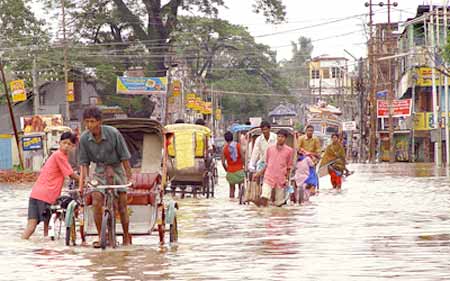
It continued to rain all day and through till the next day.  Then the rain started to pick up.  Buckets of rain were coming down for hours.  I had been cooped up in the hotel room for the past 24hrs with a fever and it was time for me to venture out and get food/hit up the internet cafe.  As I stepped out of the hotel, the street around me was quite dry and I was starting to wonder what the big deal was.  I found it 3 seconds later.  When I turned the corner onto Sutter St. (our friend Ebony rightly dubbed it "Flooder St"), the water was up past my knees. Taxis and auto rickshaws are stalled in the middle of the street because the water is up past the engine and the only trustworthy form of transportation are the man-pulled rickshaws, except I already feel guilty enough making them pull me on dry land so 3ft of water added to that didn't exactly ease that feeling.  There is a nice layer of sewage/trash on top of the water and it's so dirty that you can't even see your feet.  I prayed every time something touched my leg that it was only a plastic bag...I'm sticking with that. 

But, as Pam said, while this sounds horrible, it was actually quite fun! (minus the possible diseases).  Kinda like how it was always a huge thrill when  you were a kid if you got to swim in your clothes...doing the forbidden is always much more fun!  We'll see if I'm still saying that by the end of this trip but for now the cooler weather and excitement of it is a lot of fun!

PS-these pictures are from google...the reason for that is, I was under the impression that the flooding would be lasting longer than the 12 or so hours it was here...therefore, I did not jump on the opportunity to take pictures and the next thing I knew, the flood was gone! Darn manholes...we will try and get more pictures up soon though!

Thursday, June 16, 2011

The Sense of the Sacred - John

Couple things.  First of all I would like apologize for the lack of pictures on this blog.  Unfortunately, but understandably, the missionaries of charity to not allow volunteers to photograph any of their apostolates until a volunteer's final day in Kolkata.  Our pictures likely won't be posted until our return to the US.  Also, the following blog is merely my own thoughts from the past couple of weeks.  None of these thoughts are novel, but I think this blog's topic deserving of reflection.  Hope you find it interesting.

America is a developed country.  To take a crack at this term's meaning I would propose that in a developed country the starting point, nuts and bolts of society, have been cultivated in such a way so as to produce a more advanced way of living.  Ideally, these societal advances help individuals live more meaningful lives.  Technological advances for example can allow for more efficient work which then allows for more leisure and recreation.  While such advances can bring about genuine good, my experience in India has heightened my awareness of a potential danger faced by citizens of developed countries. 

I worry that many citizens in developed countries have lost sight of the nuts and bolts, the fabric that makes up human society.  To explain this point, I think architecture provides an accurate corollary.  Taking a walk through any major American city one comes into close contact with the marvels of modern architecture.  Our sparking 100-story buildings literally scrape the sky.  These buildings were constructing through the application of physical principles which governed every phase of their formation.  Architects study for years to learn the intricacies of these principles and their application.  Just like our society, I'm sure architecture is becoming an ever more complex thing.  As this study becomes more complex, I'm sure architects study smaller, more specialized fields.  What if modern architects, in their specialization, were to forget about basic principles such as gravity?  I worry that our society might be facing a similar problem.

In a way, everything in India is simple.  The simplicity of Indian society exposes the basic fabric which makes up human civilizations, both advanced and non-advanced.  The Kolkata street markets provide a perfect example.  Most everything a person needs to survive can be purchased within the space of a few city blocks.  Such products as meat and vegetables are hauled in from villages every morning and sold in the city throughout the day.  The economics lie bare before everyone's eyes: things are simple.  The same can be said for families.  Kolkata sidewalks are littered with makeshift leantos, often made with a few strings and large plastic tarps.  A look inside many of these haphazard tents will reveal a mother sitting cross-legged on the pavement tending to her children.  A basic building block of society, the family, is literally put on the streets for all to see.  Have western, developed countries lost sight of the importance of the family?

In addition to basic economics and the family, there is one other building block which we have maybe overlooked.  After spending a five weeks walking the streets of Kolkata, I don't think anyone would deny the religious nature of the Indian people.  Religion is everywhere.  Nearly every other block has at least one small mosque or Hindu temple wedged in-between the various small shops.  Every couple of hours the Islamic call to prayer sounds.  Sikh men walk around with Turbans on their heads, and crosses adorn the necks of the occasional Christian.  It was this religious atmosphere which prompted Dominique Lapierre to remark in The City of Joy that, "Indian people have a deep sense of the sacred." 

Though this sense is expressed in many different religions, its present everywhere in Kolkata.  Not only do Indians have a deep sense of the sacred, their religious nature is expressed in their most beautiful buildings.  The temples, mosques, and churches are undeniably among the most beautiful constructions on the city's streets (Kolkata's shopping malls pale in comparison).  These places of worship  sit at the heart of Indian society.  Though it might be expressed in different religions, the "sense of the sacred" has a central influence upon Indian society.  

I think that the average poor Indian's willingness to express their "sense of the sacred" might have a lot do with theiracute perception of life's transience.  The slums force one to realize that life is fragile.  I have had the blessing of picking up many dieing men and women from Howrah train station and transporting them to the MC's "Home for the Dying."  These people know that life is utterly out of their hands.  In contrast to luxurious amenities such as air conditioning which often cultivate an insular sense of autonomy, those who live and die in gutters have only the change in the weather.  The poor seem to realize their dependence on things out of their own hands: their dependence on God. 

In their poverty, many Indians readily express the interior impulses of their heart.  The people of the slums are simple and perhaps less given to masking basic emotions.  They're just people, just human.  They get hungry, thirsty, frightened, make families, and worship God.  Such things seem to provide the fabric of Indian society.  And whether we realize it or not, they may serve as the foundation of our western culture as well. Whew, sorry that blog went a little long! 
  
A Geeky footnote for the philosophically minded person: Several years back I read a couple of Richard Dawkin's books including The God Delusion.  At one point in this book Dawkin's mentions this feeling of the divine, of some transcendent influence upon which humans are at least somewhat dependant.  If I recall correctly, Dawkins gives several evolutionary explanations for this feeling.  For all I know he's probably right in regards to the biology; but for anyone who thinks the way I do, I would like to point out what I believe is an unwarranted conclusion.  After giving sufficient evolutionary explanation, I have heard people argue that this "sense of the sacred" is disconnected from reality (in other words, in reality there is no God, we just have a biologically built-in sense that proved advantageous).  If this argument's conclusion were true then the reasonable person would disregard this intuitional sense.  But here I would like to point out that the biological explanation neither affirms nor denies the corresponding metaphysical reality.  Is it not plausible to think that perhaps God created this sense through the instrument of evolution?  Given independant reasons for believing in God and providential human evolutionary development, it would actually follow that this sense of the sacred actually makes sense.  If this sense does correspond to something that is real, would it not then command more respect it cultures who have strayed from, and even laughed at this intuition?  Please do not interpret the last part of this reflection as a criticism of an intellectual study of God; all things have their place.

Tuesday, June 14, 2011

Laura's post

I'm not sure if we have told you yet about our hotel so I thought I might introduce you to the guests that also live with us. In room one, we have Greer and Ebony. Greer is a nursing student from South Carolina who loves mission work and just generally being on a mission. Keeping up with her is great fun. Ebony is a nurse from Australia and about the sweetest woman you'll ever meet. Her list of pet names for people is inexhaustive (cuteness is my personal favorite). Both are leaving this week which is a horrible thought since we have become quite good friends. No one has as much fun in the rickshaw on the way home from Kalighat as the four of us. Today was full of laughter and dancing since the rickshaw driver turned on a cd which was a strange mix of techno and American rap which they have added Indian parts to. As if our rickshaw didn't draw enough attention already, we now had incredibly loud music blasting from it as well. In room one, there is also a lovely, if not rather large, rat who likes to visit the restroom via the drain in the shower. Ebony is the only one who has seen him, but we trust her.

In room two is Cora who used to work at Kalighat with us but can now be found at the train station, transporting people to Kalighat when they need it. Luckily, her blood pressure cuff and stethoscope are still with us at Kalighat for our daily patient rounds. She is a nursing student from Michigan who also loves mission work and travelling and interacting with people from other cultures.

In room three, we have Anthony and John who most of you already know. They are convinced that, at any point in time, their room is much cooler and much more free of unwanted guests.

That brings me to room four. Pam, Ally, and I share this room with an amazing, seemingly endless supply of cockroaches. Ally and I met one the other morning and he was immediately introduced to the bottom of my shoe. Another one found a new home underneath our laundry bucket. I thought of telling Pam he was residing there, but she was alseep so I thought I would let her figure it out later. One has ended up in the toilet but decided not to flush for a good day or so. Using that toilet was a psychological challenge: I know he's dead...I know he's dead...I know he's dead... Ally, being the good friend she is, was doing my weekly lice check when all of the sudden she screams, "OH MY GOSH!". I freak out thinking she found lice in my hair but then she screams cockroach. I have never jumped on top of a bed so quickly in my life!There are two very queen size beds in our room and Ally and I share one of them. After a few early morning hours of being kicked in the face every so often (Ally insists on sleeping the other way), we have found the wonderful resolution of putting a wall of pillows between us. Problem solved. Anyone caught crossing over to the wrong side is promptly whacked with no remorse from the whacker. Pam is just recovering from a fever and we are happy to have her back! According to the hotel owner, one can hear Pam's laugh all the way from Sudder street.

Saturday, June 11, 2011

Allie's Post

I wanted to tell you about a few funny/weird incidents that have occurred since I've been here.  Being in another country comes with many experiences and sometimes, when you can't understand the language, it makes for some funny situations:

Scene 1: I was sitting with a woman at Kalighat the other day during the afternoon shift.  This woman is missing an arm and a leg but she is generally quite a happy person, except when she has to take her medicine...but that's another story.  So I was sitting there, just talking to her, even though she speaks no english and is mentally challenged.  And I decide to try out my Bengali and say "Amar nam Allison" which means "My name is Allison."  And then I ask "Namke?" which is "Name?" and she just smiles at me.  So I asked her "Namke?" for probably the next 5 minutes, not even knowing if she could actually talk. All of a sudden she gets a really excited look on her face and says "Jolla!" and I'm thinking "Oh my gosh! Her name is Jolla!" Feeling like this is a huge breakthrough, I begin to end every sentence with 'Jolla,' her beautiful name! I continue to talk to her and bring her lunch..."Here's your lunch, Jolla!" I handed her lunch and all of a sudden she starts pointing and saying "Jolla" over and over again and I'm thinknig "What the-".  It looked like she was pointing towards another woman whose name happened to be Usha so I tried to explain to Jolla that Jolla was Jolla and Usha was Usha.  She obviously did not understand me and continued to point in that direction and, by this point, was shouting "JOLLA!"  I was starting to stress as she was getting all riled up and I was standing there clueless.  And that's when I see it...right behind Usha is a cup of water.  I stood up, grabbed it and handed it to her. "Jolla?" I asked uncertain.  "Jolla!" she said happily.  It was then that I realized I had just been calling this woman 'cup of water' for the past 30 minutes.  Kinda makes me wonder how silly I look on a daily basis :)

Scene 2:  There is a certain fruit here that is very popular called 'lychee.'  It looks sort of like a strawberry but it has a hard red shell with spikes on it, but when you take this outer cover off...it looks like an eyeball.  It's white and squishy and nasty.  Now, Anthony prides himself on being a 'foody' and is brave enough to try everything.  So he comes up to me before chai time at Kalighat and tells me he tried this thing and I should try it.  I think his exact words were 'It's not bad'.  This should have been my first red flag.  If Anthony isn't absolutely in love with a food item, something is wrong.  So I go over and see this bunch of lychee which basically looks like a plate of eyeballs.  Red flag number 2.  If it looks gross, it probably tastes gross.  At this point I still  have somewhat of a brain and say "Eh...I'll pass."  Good thinking, right?  Well I turn around and notice there's like 3 patients watching me.  One who speaks some english starts to grin and says "Try!".  Red flag number 3.  If a patient gets a sly grin on his face and tells you to eat something...don't.  However, quite honestly, I could not resist his smiling face, so I groaned and picked up one of the slimy, squishy, eyeball-like fruit things and popped it in my mouth. Shock does not begin to describe my reaction to this taste.  As I'm chewing it moves from sweet to spicy to salty to peppery and then all of these together.  My eyes are watering and I'm desperately chewing this disgusting fruit, trying to get to a point I can swallow.  Finally I gulp it down and try and play it off cool as the patient is looking at me expectantly.  "Good," I croak.  He saw right through that little mask...maybe it was the watering eyes that gave me away.  Or the fact that I didn't want to close my mouth until I had something to take away the taste, so I just walked around with it hanging open stupidly.  Either way, the patient bursts out "Bahahaha!" as I walk away and Anthony, being the sympathetic person he is, joined right in.  Now, Anthony will probably tell you I'm exaggerating.  I definitely am not.  My final parting advice is this: Never, I repeat, NEVER eat a lychee.

Thursday, June 9, 2011

Laura's post

Yesterday was probably one of the toughest days at Kalighat. Ally and I decided we needed some extra time off from volunteering so we decided to go to the afternoon shift from 3-5 which from my previous experience was much more peaceful. However, yesterday it was not. There were about 15 volunteers too many which added to the chaos of the extra cleaning the MCs are doing. Our shift began with a lecture from an understandably irate Sister. A patient confessed to an MC that a volunteer had given him Rs. 10 to buy drugs. The Sister was looking for the volunteer and knew that he or she usually worked the afternoon shift. Another volunteer had just recently been caught doing the same exact thing. The volunteer's defense was that it was the patient's only pleasure left in life. The Sister asked, "do you go to the hospital for treatment or for pleasure?" She looked around at the group of us, pointed at me and said, "answer the question!" I practically passed out from being singled out like that and felt incredibly guilty even though I have never given any patient anything. For the next hour or so I worked quietly, trying to stay out of the way.

The day did not get better. Because I am a nursing student, they allow me to do certian things like give feedings through a feeding tube. The woman who I was giving  feeding to is very close to dying. She began to vomit up the feeding and I honestly thought she was about to die right there and that it was my fault. What I needed, a suction, was not available, so the only thing we could do was place her on her side and wipe up the vomit as it came out of her mouth. Ally and I stayed with her until she was comfortable again.

At the end of the day, we were able to go to Adoration and be filled with God's peace. We were there for the patient, even though it was hard and we felt useless. We brought Jesus to her soul which is what we are there to do. Last Sunday at the volunteer time of sharing, one of the Sisters shared a beautiful insight into the 2nd Joyful mystery, the Visitation. Mary's main purpose in going to visit Elizabeth was not to give her companionship and help during her pregnancy, but rather, it was to sanctify John by bringing Jesus to him. That is what we are called to do each day at Kalighat and in every other area of our lives.

Sunday, June 5, 2011

Allie's Post

After almost 2 weeks in Kolkata, I'm finally starting to feel that I can call this place home for the next two months.  As Laura said before, we were both down for the count for a few days with a lovely little illness.  I'll spare you the details but lets just say we both feel MUCH better now :)  It was a bit discouraging to hang out in the room for 4 days but thanks to the massive amounts of prayer from everyone and God's beautiful grace, that zeal to work with the poor has indeed doubled.

Working at Kalighat has definitely been an eye-opening experience so far!  Initially, I thought the hardest part would be the language barrier.  It seemed very difficult to build a relationship with people who spoke a totally different language or, in some cases, could not speak at all.  God's lesson Part 1: Loving someone solely based on the fact that they are human is a humbling and beautiful experience.  I believe that it was St. Francis of Assisi who said "Preach the gospel at all times and when necessary, use words."  Words are not necessary here.  The other day I was taking blood pressures in the men's ward and a new man had just arrived the day before.  He had suffered a stroke and was completely incapable of speech and had very limited control of his limbs.  After I took his blood pressure, I sat with him for a while and just had my hand on his arm. Eventually he started to wave that arm around.  I couldn't tell what he wanted, so I tried to offer him a glass of water and a few other things.  He waved them all away and then something clicked in my mind.  I grabbed his hand and placed it in mine and then he turned his head slowly and stared at me, blinking a couple of times and closing his hand around mine.  As I sat there holding his hand, the importance of this mission hit me.  I wasn't sure if this man had ever known love.  And for some reason, I was the one sitting there with him, in the last days of his life.  What he wanted was not more medical care, food, or water but my love instead.  This is Jesus.  It was a perfect reflection of Jesus on the cross..."I thirst".  He thirsts for our love! What a beautiful way for Him to reveal this! 

One of Mother Teresa's most important messages was this:  "We think sometimes that poverty is only being hungry, naked and homeless. The poverty of being unwanted, unloved and uncared for is the greatest poverty. We must start in our own homes to remedy this kind of poverty."  This kind of poverty is not only found in Kolkata.  It's everywhere.  That is why Mother Teresa's example is so powerful...it's so universal.  MT stated, "Did not Jesus say: 'Amen, I say to you, whatever you did for the least brothers of mine, you did for me'.  It is here, at this point, that you and I are written into God's plan."


Saturday, June 4, 2011

Human Dignity

Most of the patients delivered to Mother Teresa's various Kolkata centers come from either Howrah or Sealdah train station.  Volunteers patrol these stations on a daily basis in search of the sick, dying, and mentally handicapped.  Upon finding a potential patient, the volunteers will usually carry the poor man or woman to the street and hail a taxi.  At this point a argument typically ensues between the volunteer and taxi driver, who understandibly is concerned about transporting the sometimes half-dead patient.  Once the volunteer and driver arrive at a fair price, the patient is delivered to one of the MC centers.  Immediately following their arrival at a center the patient is cleaned, fed, given a fresh set of clothes, and assigned a bed.  Patients may still with the MCs for a couple of days, or they may stay for several years.  The transformation that occurs, both mental and physical, over the course of a patient's stay is fascinating.  I think this transformative process gets to the heart of Mother Teresa's work: restoring dignity.

During the past several weeks I have had the pleasure of  seeing this transformation occur.  Many of the patients found at the stations have been stripped of all human dignity.  Many lie prostrate on the train station platforms amidst piles of their own fecies, simply to weak to move.  Travelors at the bustling stations carefully avoid their dying companions, eager to reach their destination on time.  Unseen and unloved, these future patients have lost all human dignity.  By taking these patients into their care, the missionaries of charity restore hope to the eyes of individuals who may have completely given up.  This hope returns usually develops slowly under the careful encouragement of the sisters at the MC Centers.  Patents enter lacking both health and dignity, and often leave with both restored.

Not only do the missionaries change the lives of their patients, they also spread christian charity and human dignity throughout the societies in which they work.  After working with a particularly emaciated man at Howrah station, I was approached by an Indian passerby.  The Indian proposed that instead of nursing such a man back to health, I should be delivering euthanization pills.  In response I tried to explain the concept of inherant human dignity, a cause for which Mother Teresa was such a stauch proponent.  I don't know if the conversation was fruitful, but it caused me to reflect upon the cause for human dignity in a poverty stricken country.  In India poverty is so widespread, there is a strong temptation to throw in the towel.  There are so many who have lost all their dignity, who seem completely abandoned by society, why even try to help them?  The sheer magnitude of the problem tempts one to reject the concept of inherant human dignity.  The Missionaries of Charity seek to help societies, cultures, and countries resist this temptation.  Their charitible work is a witness.  This witness works to motivate citizens into solidarity with the poorest of the poor.

Friday, June 3, 2011

Laura's post

Well, I can officially say that mission work has lost its glamour and now it is down to the real work of prayer, work, and lots of sacrifice and sufferring. Once Allie finished her bout of "Dehli belly" I was lucky enough to pick up where she left off. I have been laying in bed for the past two days being force fed by my wonderful student nurse, Allie. I did manage to make it out of bed for adoration last night where God reassured me that sufferring does have meaning. This lesson could not have come at a better time because, ten minutes later, I was in the street, throwing up in front of a few beggers asking for money.

For now though I feel great and am looking forward to going back to Kalighat tomorrow! In the words of one of my very wise sisters, "chin up...you can do this".